Search this question online and the answers range from three months to two years. Both are technically true, and neither is useful on its own. The honest answer depends on three things: which path you choose, how many hours a week you can genuinely commit, and whether you are learning with structure or figuring it out alone.
The honest range, and why it varies
What follows is a realistic range built from how those factors actually play out — not the fastest possible case, and not the slowest.
Front-end and full-stack are two different timelines
The single biggest factor is which path you pick, and the two common ones take meaningfully different amounts of time.
Front-end: 3 to 5 months
Full-stack: 6 to 9 months
If you are choosing purely on speed to first job, front-end wins. If you are choosing on long-term flexibility and want to be useful to smaller teams and startups, full-stack is worth the extra months.
The part most timelines leave out
Most estimates stop the moment your skills are ready. In practice, having a job-ready portfolio and having a job offer are two different milestones, separated by real time.
Being ready and being hired are separated by one to three months that nobody puts in the estimate.
Once the portfolio is genuinely ready, applying, interviewing and landing an offer commonly takes another one to three months. That is not a sign anything went wrong.
A realistic month-by-month path
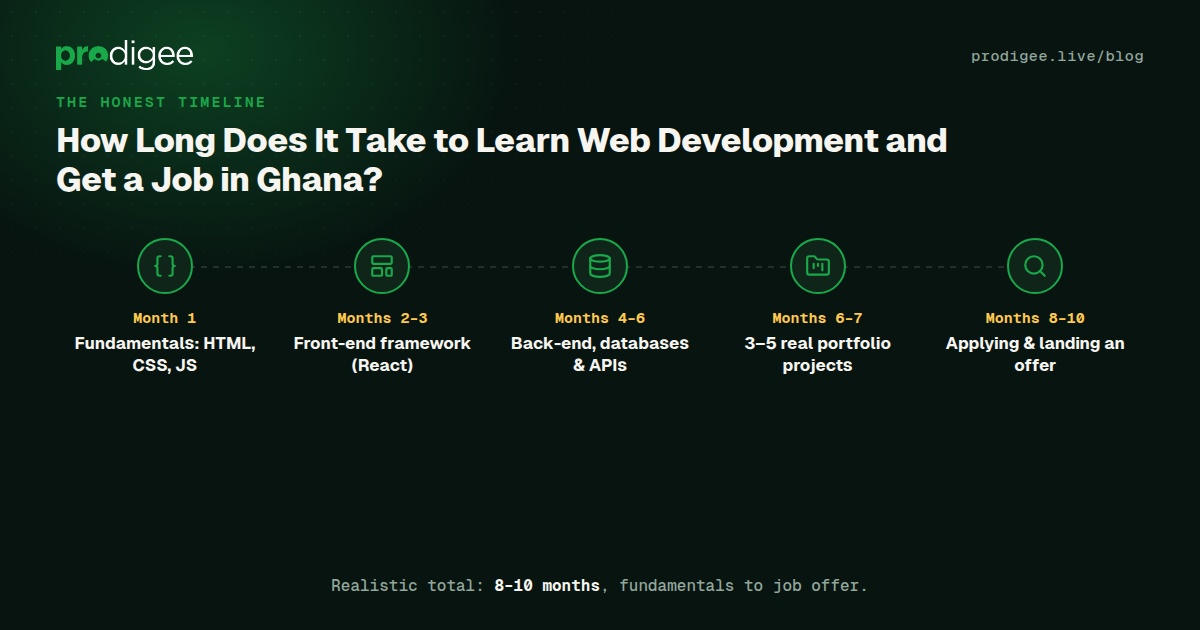
Here is what a full-stack path looks like end to end, assuming consistent part-time study.
Month 1 — Fundamentals: HTML, CSS, JavaScript
The essential building blocks. Most beginners get comfortable with the basics of all three within a few weeks of consistent practice.
Months 2–3 — Front-end tools and a framework
Moving from static pages to interactive, real applications. This is usually where front-end-only learners reach a job-ready level.
Months 4–6 — Back-end, databases and APIs
Server logic, a database, and how the front-end and back-end talk to each other. This is the stretch that separates front-end from full-stack.
Months 6–7 — Three to five real portfolio projects
Projects that solve a real problem, not tutorial copies. This is what recruiters actually open, often before a CV.
Months 8–10 — Applying, interviewing, landing an offer
The job search itself. Expect rejections along the way; they're normal, not a signal you picked the wrong path.

What speeds it up, and what slows it down
Speeds it up
- Consistent daily study — even an hour beats irregular long sessions
- Structured, project-based learning instead of scattered free tutorials
- Prior experience with logical or analytical work
- A study community or mentor to unblock you when stuck
Slows it down
- Jumping between unrelated tutorials with no clear path
- Skipping project-building in favour of endless video watching
- Learning entirely alone with nobody to ask when stuck
- Waiting to feel ready before starting to apply
Structure is the biggest lever you control. Two people with the same number of study hours can land in very different places: the one following a structured, project-based path consistently tends to reach job-ready far sooner than the one piecing together free tutorials without a clear order.
Getting started on Prodigee
Prodigee Edtech's web development track is built around exactly this kind of structured, project-based path, designed to move you from fundamentals to a job-ready portfolio without the guesswork of assembling free tutorials on your own.
Ready to start your own timeline?
Browse the web development track and start building the portfolio that gets you hired.
Browse coursesFrequently asked questions
- How long does it take to learn web development from scratch?
- Most complete beginners reach a job-ready front-end level in 3 to 5 months studying around 15 to 20 hours a week. Full-stack development typically takes 6 to 9 months of consistent study to reach the same level.
- Should I learn front-end or full-stack first?
- Front-end is generally the faster path to a first job, since it has fewer moving parts. Full-stack takes longer but can make you more versatile for smaller companies that want one person who can build an entire feature.
- Does the job search itself take extra time?
- Yes, and it's often left out of timeline estimates. Once your portfolio is ready, applying, interviewing, and landing an offer commonly takes another 1 to 3 months on top of the learning phase.
- Can I learn web development while working full-time?
- Yes, this is how most career switchers do it. It extends the timeline since you're studying part-time, but consistent evening and weekend study adds up faster than irregular, unpredictable sessions.
References
This article draws on the following sources, linked so you can read further.
- How Long Does It Take to Become a Web Developer From Zero?, LocalPro1 InstituteBreakdown of front-end, back-end, and full-stack timelines, plus the job search phase.
- How Long Does It Typically Take to Learn Enough Web Development to Get a Job, MediumComparison of self-taught vs. bootcamp learning paths and their typical timelines.
- Web Development: How Long Does It Take to Learn?, Noble DesktopOverview of realistic timelines for building practical, job-ready web development skills.
- Web Developer Programme, Generation GhanaA Ghana-based structured bootcamp programme for aspiring web developers, including job placement support.